

Bay Window Blinds: Curved Vertical Track vs Shutters vs Roman Blinds
Walk down almost any street in Earlsdon, Stoke or Stivichall and you’ll see them: bay windows. Coventry has thousands of them — the canted bays on Victorian and Edwardian terraces, the gently curved bows on 1930s semis, and the square bays on plenty of newer homes. They’re lovely to live with and awkward to dress. Standard blinds are made for flat windows, and a bay is anything but flat.
We’ve been measuring and fitting bay windows across Coventry and Warwickshire since 2007, and three options come up again and again: curved vertical track blinds, bay window plantation shutters and Roman blinds. Each one suits a different bay, a different room and a different budget. Here’s how we help customers choose.
First, what kind of bay do you have?
The shape of your bay narrows the options before anything else does:
- Square bays — three flat faces meeting at right angles. Common on newer homes and some Edwardian properties. Almost every option works.
- Splayed (canted) bays — the classic Victorian bay, with angled side windows, usually at around 135 degrees to the front. Very common in Coventry’s older terraces. Every option works, but the corners need care.
- Curved or bow bays — one continuous curve rather than separate flat faces. You’ll see these on many 1930s semis, and this is where products designed for flat windows struggle most.
It’s also worth checking two practical things before you decide: whether there’s a radiator under the bay, and how deep the window board is. Both affect which option will sit neatly.
Option 1: Curved vertical track blinds
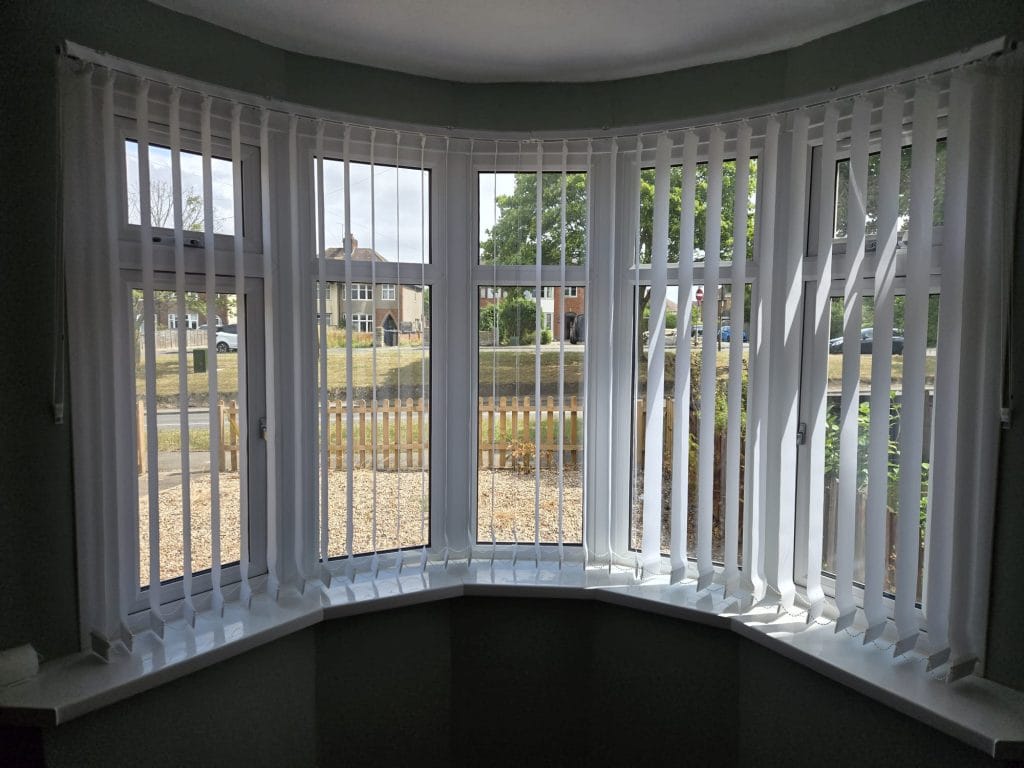
A curved vertical blind hangs from an aluminium headrail that’s shaped to follow the exact line of your bay. We laser-measure the curve on a home visit, shape the track to match in our Coventry workshop, and cut each louvre to the right drop — so the blind glides round the bay in one continuous run instead of stopping and starting at every corner.
Why people choose them:
- One blind covers the whole bay, so there are no gaps where the bay turns.
- You can draw the louvres fully to one side, or split them to both sides, and open up the entire window.
- A wide choice of fabrics — blackout, dim-out, light-filtering, thermal, waterproof and sheer voile.
- They hang clear of the window board, so a radiator underneath isn’t a problem.
- Motorised operation is available, which is handy where the track is hard to reach.
Things to bear in mind: verticals have a more practical, contemporary look than shutters or Roman blinds. A curved track is bespoke engineering, so it costs more than a standard straight vertical blind, and you should allow two to three weeks from order to fitting.
Best for: curved and bow bays, larger bays, bedrooms that need blackout, and anyone who wants the whole bay covered by a single blind.
Option 2: Bay window plantation shutters
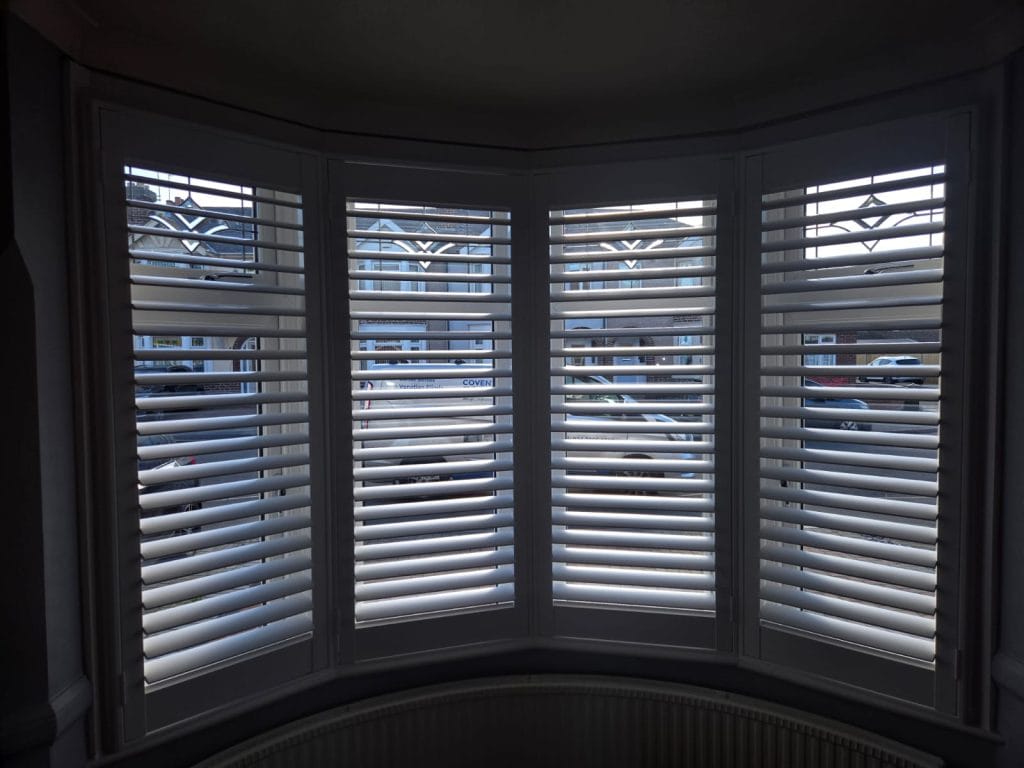
Shutters are the premium choice, and in a Victorian or Edwardian front room they’re hard to beat. Each panel is made in our Coventry workshop to the angle of your bay, with bespoke frames so the shutters sit flush all the way round. The finished result looks like built-in joinery rather than something added afterwards.
Why people choose them:
- Independent control — tilt one panel for morning light and keep the rest closed for privacy.
- They change the look of the room from inside and add kerb appeal from the street.
- A choice of styles: full height for a clean, uninterrupted line, or tier-on-tier for the most flexibility with light and privacy.
- Durable, easy to wipe clean, and an extra layer between you and a cold pane of glass.
Things to bear in mind: shutters are the biggest investment of the three. Bay window shutters typically cost from around £800 to £2,100, depending on the size of the bay, the number of panels, the material and the style — our shutter cost guide goes into more detail. A bay usually takes our fitters a full day. If there’s a radiator directly under the bay, it sometimes needs to come off the wall while the frame goes in; we’ll check this at the survey.
Best for: splayed and square bays in period homes, front rooms where kerb appeal matters, and anyone planning to stay put and add value.
Option 3: Roman blinds
If you want softness and colour, Roman blinds bring the warmth of fabric with the tidiness of a blind. In a bay, we normally fit a separate Roman blind to each window face — so a three-sided bay has three blinds, each hung precisely and dressed so the folds sit evenly.
Why people choose them:
- Hundreds of fabrics — linens, velvets, weaves, prints and plains — so they can pull a whole room scheme together.
- Blackout and thermal linings are available, which suits bedrooms and older, draughtier windows.
- When raised, they fold neatly at the top of each window and leave the sill clear.
- Each blind can be raised or lowered on its own, and they can be motorised.
Things to bear in mind: because each blind covers one flat face, Romans work best on square and splayed bays — a continuous curve has no flat faces to fit them to. On any bay you’ll see small light gaps where the blinds meet at the corners, and the folded fabric takes up some of the window height when the blinds are raised.
Best for: square and splayed bays, living rooms and bedrooms where you want a softer, decorative finish.
At a glance: which suits your bay?
| Curved vertical track | Plantation shutters | Roman blinds | |
|---|---|---|---|
| Bay shapes | All — ideal for curves and bows | All, made to your bay’s angles | Best on square and splayed bays |
| Look | Clean and contemporary | Built-in, premium joinery | Soft, decorative fabric |
| Light control | Tilt louvres or draw fully aside | Tilt each panel independently | Raise or lower each blind |
| Corners | One continuous run, no gaps | Bespoke frames, flush fit | Small light gaps between blinds |
| Radiator under the bay | No problem | Checked at survey | No problem |
| Price guide | Written quote after survey | Around £800–£2,100 for a bay | Written quote after survey |
What we’d suggest for common Coventry bays
- 1930s semi with a curved bow bay: a curved vertical track is usually the neatest answer — one blind, no gaps, and a big choice of fabrics.
- Victorian or Edwardian front room with a splayed bay: full-height or tier-on-tier shutters make the most of the period features and look superb from the street.
- Bay window bedroom: curved verticals in blackout fabric, or Roman blinds with a blackout lining. Shutters give excellent light control too, though they won’t make a room as dark as a blackout fabric.
- Bay with a radiator underneath: curved verticals or Roman blinds hang clear of it. Shutters can still work — we’ll look at it during the survey.
Frequently asked questions
Can any bay window take blinds or shutters?
Almost always. We’ve fitted square bays, splayed 135-degree bays, curved Edwardian bows and deep canted bays. The free survey lets us confirm the best approach for your window.
How long does it take?
Curved vertical track blinds typically take two to three weeks from order to fitting, because the track is shaped and the louvres cut individually. Bay shutters usually take our fitters a full day to install once the panels are made.
Do you charge for measuring?
No. The home survey and written quote are free, with no obligation to go ahead.
Book a free bay window survey
Every bay is different, and the only way to measure one properly is in person. We’ll visit, map your bay’s angles, bring fabric and shutter samples to hold up at the window, and follow up with a clear written quote. Call us on 02476 661092 or book your free home survey online. We cover Coventry, Kenilworth, Leamington Spa, Warwick, Rugby, Nuneaton, Stratford-upon-Avon and the surrounding villages.